About Ring Main Unit (RMU)
Ring Main Unit (RMU)
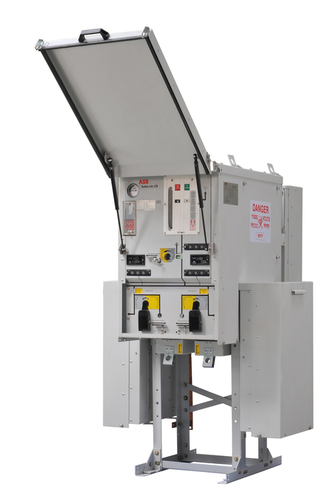
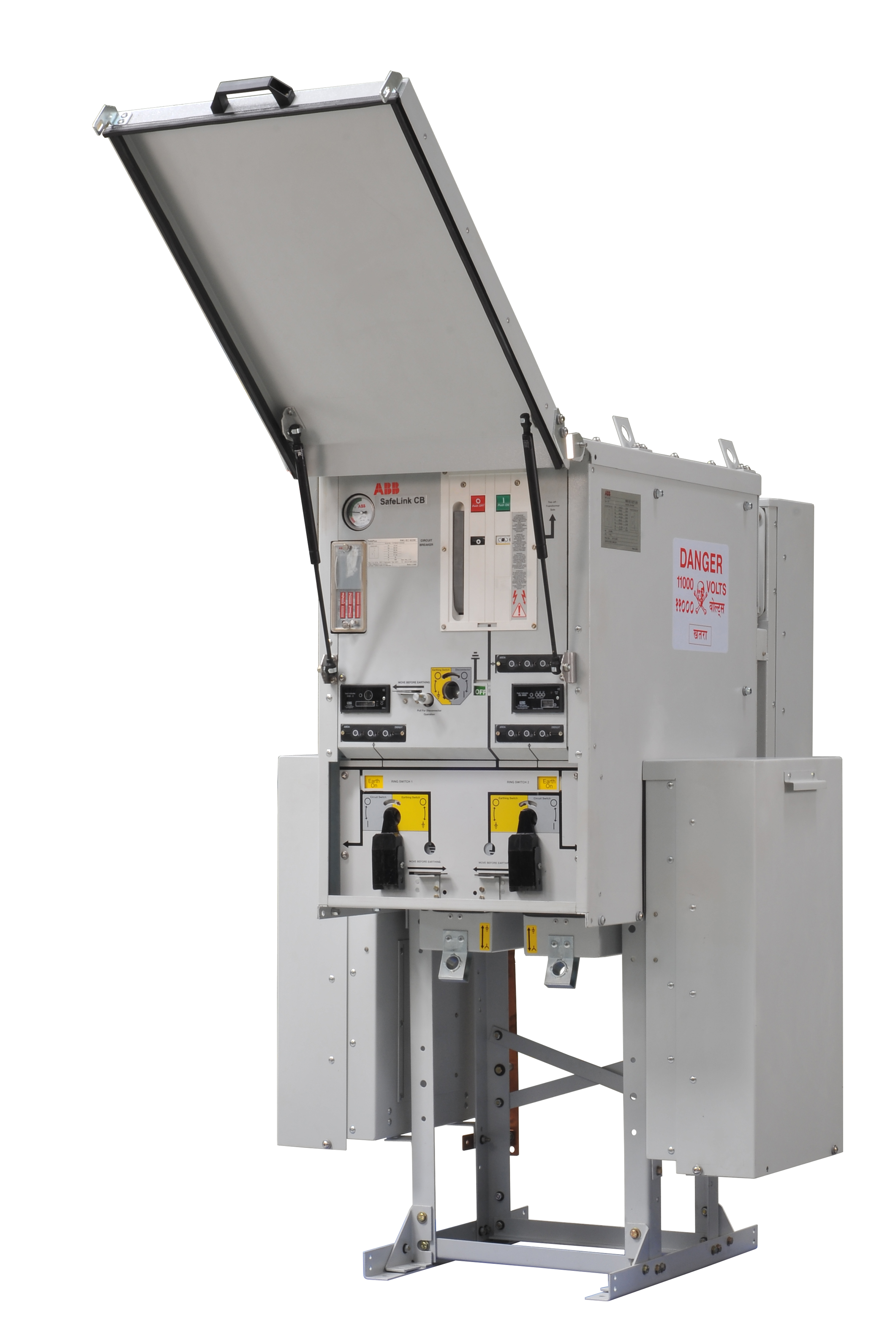
The RMU is intended to be used in medium voltage (11KV to 33KV) Ring distribution system in any power supply/distribution utilities. RMU offers greater flexibility in supply system in maintaining continuity and offers practically maintenance free operation. The RMUs are very compact in size compared to MV switchgear panels. RMU cubicles form a system of small size modular equipment for Medium Voltage (11KV & 22KV for India ), each module having a specific function. Every function has its own metal enclosure, which contains a stainless steel/Epoxy tank filled with SF6 gas, in which the switching devices and busbar are kept. Full SF6 makes equipment pollution resistant and able to withstand even the flooding of MV sub-station. SF6 gas being inert, electro-negative and non-inflamable gas has many physical & chemical advantages.
The RMU gas tank is a permanently sealed system where the integrity of the seal is effective for 30 years in conformance with IEC-298. The tank charged with SF6 gas to the pressure of 0.03 Mpa which allows switch to break loads of upto 2600 amps at 12KV or 1300 Amps at 24KV (which under normal atmospheric conditions 630 amps at 12KV, that is, without SF6 gas). The RMU switching system consists of 3 phase, 3 position load breaking & fault making, the three positions being "close", "open", and "earth". The actuating is linked with the external earth switch as well as the panel door so as to provide safety interlocks which ensures that the operator may only access the panel when the system is isolated and earthed. The most common versions of RMU are Extensible & Non-extensible types - 3 Function & 4 Functions. A typical 3 function RMU shall comprise of 2 x 630 Amps Load Break Switch + 1 x 200/400/630 Amps Circuit Breaker (SF-6 or Vacuum type). Similarly, a typical 4 Function RMU will comprise of 2 x 630 Amps Load Break switch + 2 x 200/400/630 Amps Circuit-Breaker. The busbar is capable of carrying a load current of 630 Amps and the short circuit fault current of 20 KA for 3 secs. The system of mounting the bus bars conform to IEC 298.
The RMU generally conforms to the following standards
- Load Break Switch - IEC 265/BS 3804
- Load Break Sw. + Fuses - IEC 420/BS 16926
- Circuit Breaker - IEC 56/BS 5311/IS 13118
- Earthing Switch - IEC 129/BS 1985
- Monitoring & Control - IEC 801
- Degree of Protection - IEC 529
- Metal enclosed switchgear - IEC 298/BS 5311/BS 5227
General Characteristics:
- SF6 insulated compact switchgear
- Equipped with SF6 switch disconnector
- Equipped with vacuum circuit breaker
- Developed according to International Standard IEC 62271-200
- Insensitive to environmental conditions
- Modular or compact version
- Internal arc resistance
- Increased mechanical and electrical life (class E3 M2)
- Stainless steel tank
Technical Data:
|
Electrical Data
|
|
|
|
Rated voltage
|
kV
|
12
|
|
Insulation level
|
|
|
|
lightning impulse (1.2/50 ms)
|
kV peak
|
28
|
|
power frequency (50 Hz / 1min)
|
kV r.m.s
|
75
|
|
Rated current
|
A
|
up to 630
|
|
Rated short-time current
|
kA r.m.s
|
21 (3s)
|
|
Short circuit making current
|
kA peak
|
52.5
|
|
Ambient temperature
|
oC
|
basic: - 5 .. +40 option: -10.. +55
|
|
Dimensions (2 IS + 1 DC)
|
|
|
|
Height
|
mm
|
1810
|
|
Width
|
mm
|
780
|
|
Depth
|
mm
|
885 (Trafo Version); 1105 (Free Standing Version)
|
Advanced Protection and ReliabilityEngineered with SF6 gas insulation and hermetically sealed design, this RMU provides reliable arc protection and high short-circuit resilience. The rated 20 kA for 3 seconds ensures system stability during faults, while the make-proof, interlocked earthing switch adds an extra layer of operational safety, making it a preferred choice for critical power distribution applications.
Flexible and User-Friendly ConfigurationWith options for manual or motorized operation, and front-accessible cable compartments, this RMU adapts to various application challenges. It supports both LBS and VCB switching devices, allowing customization to meet specific network requirements. The extensible busbar design enables seamless expansion for future system upgradation.
FAQs of Ring Main Unit (RMU):
Q: How does the SF6 Gas Insulated RMU ensure safety during internal arc faults?
A: The RMU incorporates automatic pressure relief features and SF6 gas insulation. In the event of an internal arc, the pressure relief mechanism safely vents gases to prevent enclosure damage, safeguarding operators and equipment.
Q: What are the main benefits of using a hermetically sealed SF6 compartment in this RMU?
A: A hermetically sealed SF6 compartment ensures minimal gas leakage and long-term insulation performance. This results in a maintenance-free operation, improved reliability, and enhanced protection against environmental factors.
Q: When is it suitable to deploy the RMU with a 20 kA short circuit rating?
A: The RMU with a 20 kA short circuit rating is best used in secondary distribution networks and switchgear protection schemes where high fault current levels are expected, ensuring robust system integrity during faults.
Q: Where can this RMU be installed, considering its design and protection degree?
A: Thanks to its compact, floor-mounted design and IP4X/IP2X protection degrees, the RMU can be deployed in indoor substations, commercial buildings, and industrial facilities where space efficiency and enhanced protection are required.
Q: What is the process for switching operations and how many are supported?
A: The RMU is equipped with spring-operated mechanisms, supporting up to 10,000 mechanical operations for both manual and optional motorized switching, ensuring dependable performance throughout its service life.
Q: How does the RMU accommodate different cable configurations and types?
A: Its front-accessible cable compartment is designed to accept 3-core and 4-core cables, with included cable clamps and test terminals, facilitating quick installation and easy maintenance for various applications.
Q: What usage advantages does SCADA compatibility offer with this RMU?
A: SCADA compatibility enables remote monitoring and control, improving operational efficiency, allowing quick response to network changes, and enhancing overall reliability in power distribution management.


 Send Inquiry



 Send Inquiry
